📋 Executive Summary
Yes — anabolic-androgenic steroids (AAS) can directly accelerate androgenic alopecia (male/female pattern baldness) in individuals with a genetic predisposition. The mechanism is clear: exogenous androgens elevate the testosterone pool, which is converted via the 5-alpha reductase (5AR) enzyme to dihydrotestosterone (DHT) — a compound 3–10× more potent than testosterone at scalp androgen receptors. DHT shortens the hair follicle’s growth (anagen) phase and gradually miniaturizes the follicle until it can no longer produce visible hair. Not all steroids carry equal risk, and not all users are equally susceptible. This article explains the full mechanism, ranks compounds by risk, and outlines evidence-based mitigation strategies.
How Anabolic Steroids Trigger Hair Loss: The DHT Mechanism
What Is DHT and Why Does It Attack Hair Follicles?
Dihydrotestosterone (DHT) is an androgen hormone derived from testosterone via the action of the enzyme 5-alpha reductase (5AR). While testosterone itself is the primary male sex hormone, DHT is 3–10 times more potent at androgen receptors. In most tissues, this potency is beneficial. At the scalp, however, it initiates a damaging cascade in genetically predisposed individuals.
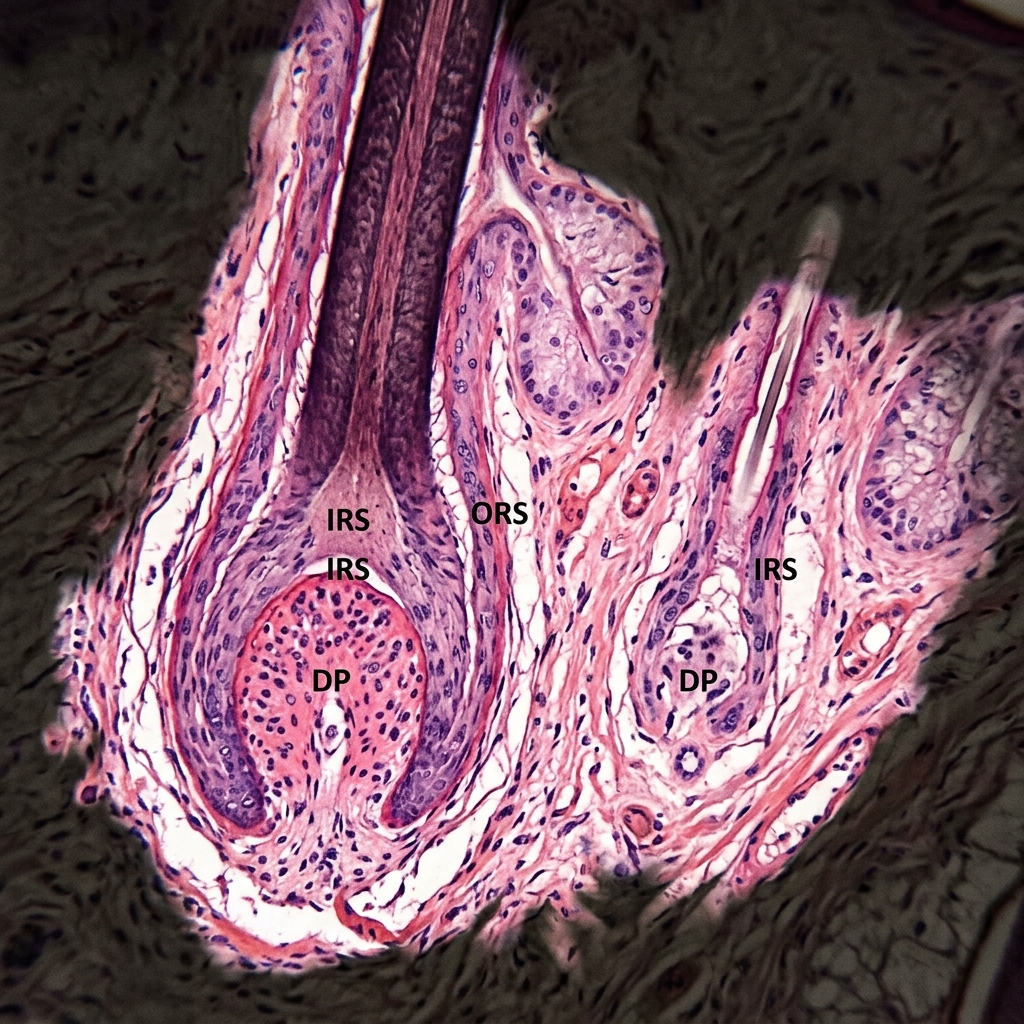
When DHT binds to androgen receptors within the dermal papilla — the structure at the base of each hair follicle responsible for regulating growth — it triggers a series of molecular events that progressively shorten the follicle’s anagen (active growth) phase and lengthen the telogen (resting/shedding) phase. Over successive hair cycles, the follicle undergoes miniaturization: it shrinks, producing progressively thinner, shorter, and more depigmented hair until it ceases terminal hair production entirely. According to NIH StatPearls, this process underlies androgenetic alopecia (AGA), the most common cause of hair loss in men and women worldwide.
The Role of 5-Alpha Reductase in Steroid-Induced Hair Loss
Anabolic-androgenic steroids accelerate this process by substantially increasing the systemic androgen load. When an individual introduces exogenous testosterone or other AAS, the pool of available substrate for 5AR conversion increases. More testosterone (or testosterone-equivalent androgens) entering the 5AR pathway means proportionally greater DHT production — at the scalp, prostate, and skin. The 5AR enzyme exists in two isoforms: Type I (predominant in skin and liver) and Type II (predominant in hair follicles and prostate). Both isoforms contribute to DHT synthesis, but Type II is the primary driver of AGA.
Hair Follicle Miniaturization: From Terminal Hair to Vellus Fuzz
The progression from healthy terminal hair to vellus (fine, colorless) hair follows a predictable pattern in AGA. Each successive hair cycle produces a slightly smaller, weaker follicle. Once miniaturization is advanced, the process is largely irreversible without medical intervention — existing miniaturized follicles rarely regain full function even after androgen exposure ceases. This is a critical distinction: steroid-accelerated hair loss may stabilize after discontinuation, but hair already lost to miniaturization is unlikely to spontaneously recover.
An important anatomical paradox: DHT promotes growth of beard and body hair (via androgen receptor sensitivity in those follicles) while suppressing scalp follicles. This site-specific variation in androgen sensitivity explains why some men simultaneously develop significant facial hair and lose scalp hair on the same cycle.
Genetic Predisposition: The Single Biggest Risk Factor
How to Know If You’re Genetically Vulnerable Before You Cycle
Steroid-induced hair loss does not affect all users equally. The foundational prerequisite is genetic androgen receptor sensitivity, encoded on a gene on the X chromosome — meaning maternal inheritance is a primary determinant of risk. Practical pre-cycle risk indicators include: a father with male pattern baldness (MPB), maternal grandfather with MPB, or maternal uncles with significant hair loss.
The biological mechanism involves variation in the androgen receptor (AR) gene, specifically the length of CAG trinucleotide repeats. Shorter CAG repeat sequences correlate with higher AR sensitivity — meaning less DHT is needed to trigger the same degree of follicular damage. Individuals with this polymorphism are disproportionately vulnerable to AAS-induced acceleration of AGA.
The ‘Norwood Scale Acceleration’ Concept Explained
The Norwood-Hamilton Scale classifies male pattern baldness from Stage I (no visible recession) to Stage VII (severe loss, limited to a horseshoe-shaped fringe). In men with a predisposition, a single anabolic cycle can compress years of natural AGA progression into months. A user who might naturally reach Norwood III over a decade may reach Norwood IV or V within one or two cycles. Women are assessed using the Ludwig Scale, which classifies diffuse thinning at the crown rather than the receding hairline pattern seen in men.
ℹ️ Key Distinction: Anabolic steroids do not cause hair loss in individuals with no genetic predisposition to AGA. In genetically susceptible individuals, however, they can dramatically accelerate progression that may have otherwise remained subclinical for years or decades.
Which Steroids Cause the Most Hair Loss? Ranked by Risk
High-Risk Compounds: DHT Derivatives and Highly Androgenic AAS
Compounds that are already derivatives of DHT, or that have a very high androgenic index, pose the greatest risk to scalp hair. These include:
| Compound | Risk Level | Mechanism | Finasteride Effective? |
|---|---|---|---|
| Winstrol (Stanozolol) | HIGH | DHT-derived; does not require 5AR conversion | No |
| Masteron (Drostanolone) | HIGH | DHT-derived; high affinity for scalp ARs | No |
| Proviron (Mesterolone) | HIGH | DHT-derived; strong androgen receptor binding | No |
| Trenbolone | HIGH | 19-nor derivative; does not convert to DHT but extremely androgenic | No |
| Anadrol (Oxymetholone) | HIGH | DHT-derived; high androgenicity despite low 5AR activity | No |
| Primobolan (Methenolone) | HIGH | DHT-derived; popular as “mild” but highly androgenic at scalp | No |
| Testosterone (all esters) | MODERATE | Converts to DHT via 5AR; degree depends on dose and genetics | Partially |
| Dianabol (Methandrostenolone) | MODERATE | Some 5AR conversion; moderately androgenic | Partially |
| Nandrolone (Deca-Durabolin) | LOWER | Converts to DHN (not DHT) — weaker at scalp receptors | Not applicable |
| Anavar (Oxandrolone) | LOWER | Low androgenicity; DHT-derived but mild affinity for scalp ARs | Not applicable |
Why Finasteride Doesn’t Protect Against All Steroid-Induced Hair Loss
This is one of the most misunderstood aspects of AAS-related hair preservation. Finasteride inhibits the 5AR enzyme, reducing scalp DHT by approximately 60–70%. This is clinically meaningful for testosterone-based cycles, where a significant proportion of androgenic activity reaches the scalp via the DHT conversion pathway.
However, for DHT-derived compounds (Winstrol, Masteron, Proviron, Primobolan, Anadrol), the steroid is already in its most potent androgenic form — it does not require 5AR conversion. Finasteride therefore has no meaningful protective effect against these compounds. Users who believe finasteride is a universal hair-protection strategy during any cycle are operating on a flawed premise that can lead to significant, preventable hair loss.
Corticosteroids vs. Anabolic Steroids: Two Very Different Stories
Do Prednisone and Medical Steroids Cause Hair Loss?
Many individuals searching for information about steroids and hair loss are referring to corticosteroids — anti-inflammatory medications such as prednisone, prednisolone, dexamethasone, or hydrocortisone. These compounds are chemically and mechanistically distinct from anabolic-androgenic steroids. Corticosteroids do not elevate DHT or activate scalp androgen receptors in the manner described above, and therefore do not cause androgenic alopecia.
Long-term or high-dose systemic corticosteroid use may, however, precipitate telogen effluvium — a form of diffuse, temporary hair shedding triggered by physiological stress rather than androgenic follicular damage. This is a different mechanism and is generally reversible once the underlying cause is resolved. According to the NIH StatPearls overview of anabolic steroids, the androgenic side effects discussed in this article are specific to AAS, not anti-inflammatory corticosteroids.
Corticosteroids Can Actually Treat Certain Types of Alopecia
In a notable reversal of expectation, corticosteroids injected directly into affected scalp areas are a first-line treatment for alopecia areata — an autoimmune condition in which the immune system attacks hair follicles. Intralesional corticosteroid injections suppress this inflammatory response and can restore hair growth. The American Academy of Dermatology endorses this approach as a primary therapeutic strategy for alopecia areata.
Steroid-Induced Hair Loss in Women: What Female Users Must Know
How Female Pattern Hair Loss (FPHL) Differs From Male Pattern Baldness
Women have substantially lower baseline androgen levels than men. When AAS are introduced, even at doses considered conservative by male standards, the relative androgenic surge is proportionally much larger. The result in susceptible women is female pattern hair loss (FPHL), classified using the Ludwig Scale: diffuse thinning at the crown and along the central part, with relative preservation of the frontal hairline — distinct from the receding hairline pattern typical in men. A comprehensive review of female pattern hair loss classification and treatment in the International Journal of Dermatology outlines these distinct presentation patterns.
Virilization and Hair: The Double-Edged Androgenic Effect
Women using AAS may experience a paradoxical dual effect: scalp hair loss concurrent with increased facial and body hair growth (hirsutism). This reflects the same site-specific androgen receptor sensitivity described earlier — follicles on the face and body respond to androgenic stimulation with increased growth, while scalp follicles in susceptible individuals respond with miniaturization. Reversibility in women may be somewhat better than in men if the androgenic exposure is identified and discontinued early, but established miniaturization carries the same prognosis as in male users.
Can Steroid-Induced Hair Loss Be Stopped or Reversed?
Finasteride and Dutasteride: The 5-AR Inhibitor Approach
Finasteride (1mg daily for AGA, 5mg for BPH) inhibits Type II 5AR, reducing scalp DHT by 60–70%. In clinical trials, it demonstrably slows progression and can partially restore miniaturized follicles in early-stage AGA when used long-term. Its protective effect during AAS cycles is limited to testosterone-converting compounds, as established above. Dutasteride inhibits both Type I and Type II 5AR, achieving approximately 90% DHT reduction — more comprehensive but associated with a greater side effect profile, including sexual dysfunction, gynecomastia risk, and the debated post-finasteride syndrome. Neither is FDA-approved specifically for AAS-induced alopecia; both are used off-label for this purpose.
Minoxidil: Extending the Growth Phase While on Cycle
Minoxidil is a vasodilator that prolongs the anagen (growth) phase of the hair cycle through a mechanism independent of DHT or androgen receptors. Its mechanism involves opening ATP-sensitive potassium channels in dermal papilla cells, increasing follicular blood flow and cellular proliferation. Because it works independently of the androgen pathway, it provides some protective effect against all AAS compounds — including DHT derivatives that are unresponsive to finasteride. Topical formulations (2% and 5% solutions or foam) and low-dose oral minoxidil (0.625–1.25mg daily) are increasingly used. Minoxidil does not halt the underlying miniaturization process but slows follicular attrition and can maintain cosmetic density during cycles.
Ketoconazole Shampoo, RU58841, and Emerging Topical Treatments
Ketoconazole (an antifungal with mild anti-androgenic properties) in 2% shampoo has modest evidence for slowing AGA when used regularly; it is frequently included as a low-risk adjunct to primary treatments. RU58841 is a topical androgen receptor antagonist developed in the 1980s that competes with DHT at scalp androgen receptors, blocking its follicle-damaging effects at the site of action. It carries no FDA approval and no long-term safety data, but remains widely used in the hair loss community due to its theoretical advantage of acting on all androgens regardless of their conversion pathway. It is particularly attractive for users running DHT-derived compounds where systemic 5AR inhibitors offer no protection.
⚠️ Important: No treatment strategy fully protects hair follicles during high-dose AAS use in genetically predisposed individuals. The most effective intervention remains reducing or discontinuing androgenic compounds. Treatments can slow progression but cannot fully neutralize the androgenic stimulus produced by pharmacological doses of AAS.
Practical Hair Preservation Strategies for Steroid Users
Pre-Cycle Hair Loss Assessment: Know Your Risk Before You Start
Individuals considering AAS use should conduct a systematic pre-cycle hair risk assessment: (1) Establish current Norwood or Ludwig stage via self-examination or dermatologist consultation. (2) Document family history on both paternal and maternal sides. (3) If strong family history exists on either side, consider the risk of permanent, accelerated hair loss as a concrete and likely consequence of any cycle involving androgenic compounds. A dermatologist can perform scalp biopsy, trichoscopy, or a standardized pull test to establish a baseline and identify early miniaturization not visible to the naked eye.
Stack and Protocol Choices That Minimize Hair Loss Risk
For users with established susceptibility who choose to proceed, evidence-based risk reduction includes: (1) Avoiding all DHT-derived compounds (Winstrol, Masteron, Proviron, Primobolan, Anadrol, Trenbolone). (2) Limiting cycles to compounds with lower androgenic indices — nandrolone and oxandrolone carry meaningfully lower scalp DHT load. (3) Keeping cycle lengths shorter (10–12 weeks rather than extended blasts). (4) Using the lowest effective dose. (5) Beginning minoxidil treatment at cycle commencement, not retrospectively after visible loss begins. (6) Running finasteride concurrent with testosterone-based cycles (with the understanding that this is partially but not fully protective). (7) No cycle can be considered genuinely “hair-safe” for individuals with a strong genetic predisposition — risk reduction, not elimination, is the realistic goal.
Frequently Asked Questions About Steroids and Hair Loss
Get our latest guides, news, and insights highlighted in your Google Search & AI Overviews.