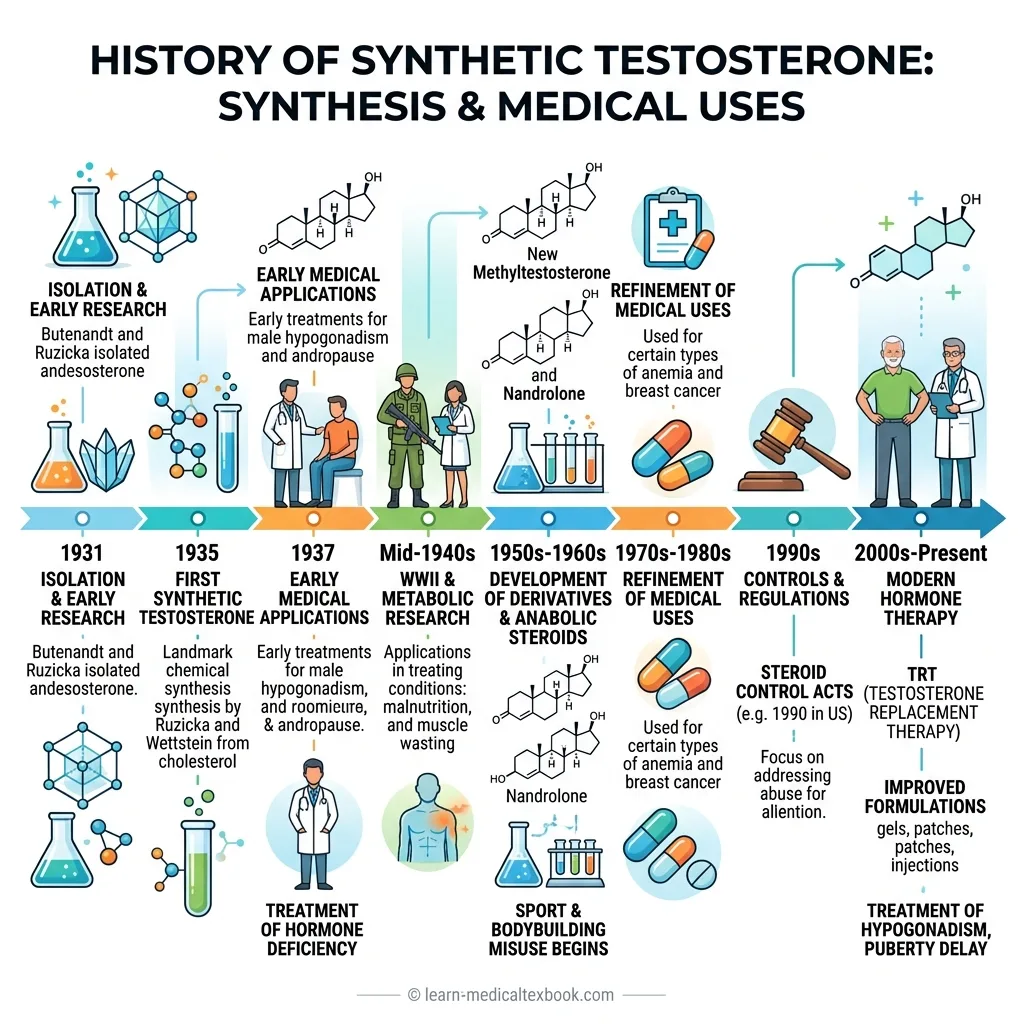
Executive Summary: Long before anabolic steroids became synonymous with sports doping and bodybuilding, they were developed as groundbreaking medical treatments. The history of synthetic testosterone dates back to the 1930s when European scientists successfully isolated and synthesized the male hormone. The original use of steroids was entirely clinical: they were designed to treat hypogonadism (the inability of the testicles to produce testosterone) and severe clinical depression in men. Following World War II, their medical application expanded rapidly to rehabilitate emaciated prisoners of war, treat severe burn victims, and combat muscle-wasting diseases. It wasn’t until the 1950s that the athletic world hijacked these clinical compounds for performance enhancement.
Today, the word “steroids” is almost exclusively associated with massive bodybuilders, disgraced Olympic sprinters, and illicit locker room deals. But before anabolic steroids became synonymous with sports doping, they were hailed as a miraculous medical breakthrough. So, what was the original use of steroids? The history of synthetic testosterone dates back to the 1930s, born in highly sophisticated European laboratories in a race to cure severe medical ailments. From treating depression to rehabilitating prisoners of war, the initial applications of anabolic steroids were purely clinical. Here is the fascinating medical history of how steroids were invented and originally used.
The Discovery of Testosterone in the 1930s
The Race to Isolate the Male Hormone
In the early 20th century, scientists understood that the testes were responsible for male physical characteristics and vitality, but they had not yet isolated the specific chemical compound responsible. The 1930s saw a fierce, highly competitive race between pharmaceutical giants in Germany, Switzerland, and the Netherlands to unlock this secret. In 1935, Ernst Laqueur and his team in the Netherlands successfully isolated the hormone from bull testicles, naming it “testosterone.”
The 1939 Nobel Prize in Chemistry
Isolating the hormone was only the first step; extracting it from animals was highly inefficient. Later that same year, two scientists working independently—Adolf Butenandt in Germany and Leopold Ruzicka in Switzerland—figured out how to synthesize testosterone from cholesterol in a laboratory. Their groundbreaking work allowed for the mass production of synthetic testosterone, earning them the Nobel Prize in Chemistry in 1939.
What Was the Original Medical Use of Steroids?
Treating Hypogonadism (Low Testosterone)
Once synthetic testosterone was available, clinical trials began immediately. The very first, primary original use of anabolic steroids was the treatment of hypogonadism—a condition where a man’s body fails to produce adequate levels of natural testosterone. Doctors prescribed these early steroids to help young men experiencing delayed puberty go through normal sexual and physical development.
Combating Severe Depression and Fatigue
Interestingly, before the advent of modern SSRI antidepressants, early endocrinologists noted the profound psychological effects of testosterone. In the late 1930s and 1940s, doctors used testosterone injections to treat older men suffering from severe clinical depression, chronic fatigue, and melancholia. Patients reported rapid improvements in mood, energy, and overall vitality.
Original Clinical Benefits
- Restored normal development in men with hypogonadism.
- Alleviated symptoms of severe depression and fatigue.
- Rebuilt life-saving muscle tissue in starving patients.
- Aided in the recovery of severe burn victims.
Early Unforeseen Consequences
- Led to virilization (development of male traits) when given to women.
- Early oral variants proved to be highly toxic to the liver.
- Paved the way for the unethical sports doping era.
Anabolic Steroids in World War II
Rehabilitating Emaciated Prisoners of War
The most dramatic medical application of early anabolic steroids occurred in the immediate aftermath of World War II. Allied medical personnel were faced with the horrific task of treating concentration camp survivors and prisoners of war who were suffering from severe, life-threatening emaciation and starvation. Because anabolic steroids forcefully promote protein synthesis, doctors successfully used them to help these fragile patients rapidly regain life-saving muscle mass and body weight.
Rumors of Nazi Super Soldiers
A persistent historical rumor suggests that Nazi Germany administered early testosterone to its soldiers to increase aggression and stamina on the battlefield. While it is true that German scientists were pioneers in hormone synthesis, historians and medical researchers have found no concrete, documented evidence of a widespread, state-sponsored steroid program for the Wehrmacht. The “Nazi super soldier” steroid story is largely considered a post-war myth.
The Post-War Medical Expansion
Treating Muscle-Wasting Diseases
Following their success in post-war rehabilitation, the medical community recognized the incredible power of anabolic compounds to preserve muscle. Throughout the 1950s and 1960s, scientists developed dozens of new steroid derivatives designed to maximize muscle growth (anabolism) while minimizing androgenic (masculinizing) side effects. These drugs were used for treating severe muscle-wasting conditions such as chronic infections, severe burns, and later, the wasting syndrome associated with HIV/AIDS.
Pediatric Use for Delayed Puberty
Steroids were also widely used in pediatric medicine. Boys suffering from extreme growth delays or “constitutional delay of growth and puberty” were given mild, carefully dosed anabolic steroids (like Oxandrolone) to jumpstart their physical development and increase their final adult height.
The Transition from Medicine to Sports
The Soviet Weightlifting Dominance
The noble medical trajectory of steroids was irrevocably altered during the Cold War. In the early 1950s, the Soviet Union’s Olympic weightlifting team began utterly dominating international competitions. The secret to their unnatural strength was eventually revealed to the West: Soviet athletes were being administered heavy doses of straight, injectable testosterone by their team doctors.
Dr. John Ziegler and the Invention of Dianabol
In response to the Soviet dominance, Dr. John Ziegler, a physician working with the US weightlifting team, returned to America and collaborated with Ciba Pharmaceuticals. His goal was to create a compound that provided the muscle-building power of the Soviet’s testosterone but with fewer side effects. The result was Methandrostenolone, famously marketed as Dianabol in 1958. This marked the definitive pivot of anabolic steroids—from a purely clinical medicine to a powerful tool for athletic performance enhancement, sparking the modern doping era.
Get our latest guides, news, and insights highlighted in your Google Search & AI Overviews.