At first glance, the butter in your kitchen, the cholesterol in your bloodstream, and the waxy coating on an apple leaf seem to have nothing in common. Yet biochemists classify all three—fats (triglycerides), steroids, and waxes—under a single molecular family: lipids. The thread that binds them is not a shared backbone or functional group, but a shared chemical behavior: they are all nonpolar, hydrophobic molecules that dissolve readily in organic solvents like chloroform and ether but stubbornly repel water. Understanding this single unifying principle unlocks why the human body stores energy as fat, why cholesterol shapes every cell membrane, and why plants coat their leaves in wax to survive drought. This article breaks down the chemistry behind each lipid class, explains the structural reasons for their hydrophobicity, and explores the diverse biological roles that make lipids indispensable to life.
The Unifying Definition: What Is a Lipid?
Hydrophobicity and Nonpolarity — The Defining Trait
In biochemistry, lipids are not defined by a strict repeating monomer unit, unlike proteins or nucleic acids. Instead, the term acts as an umbrella classification based entirely on chemical behavior. The primary defining trait of a lipid is its hydrophobicity (water-repelling nature). Because these molecules are built predominantly from carbon and hydrogen atoms sharing electrons equally (nonpolar covalent bonds), they lack a net electrical charge. Polar water molecules, therefore, cannot form hydrogen bonds with them, forcing the lipids to group together and separate from aqueous environments.
Solubility in Organic Solvents vs. Water
Clinical chemists often rely on a simple physical test to distinguish lipids from carbohydrates and proteins: solubility. Driven by the “like dissolves like” principle, lipids dissolve seamlessly in nonpolar organic solvents such as chloroform, benzene, and ether, but are completely insoluble in water. Whether it is a dense animal fat or a complex steroid hormone, they all pass this solvent solubility test.
Fats (Triglycerides): Structure and Chemistry
Glycerol Backbone and Ester Bond Formation
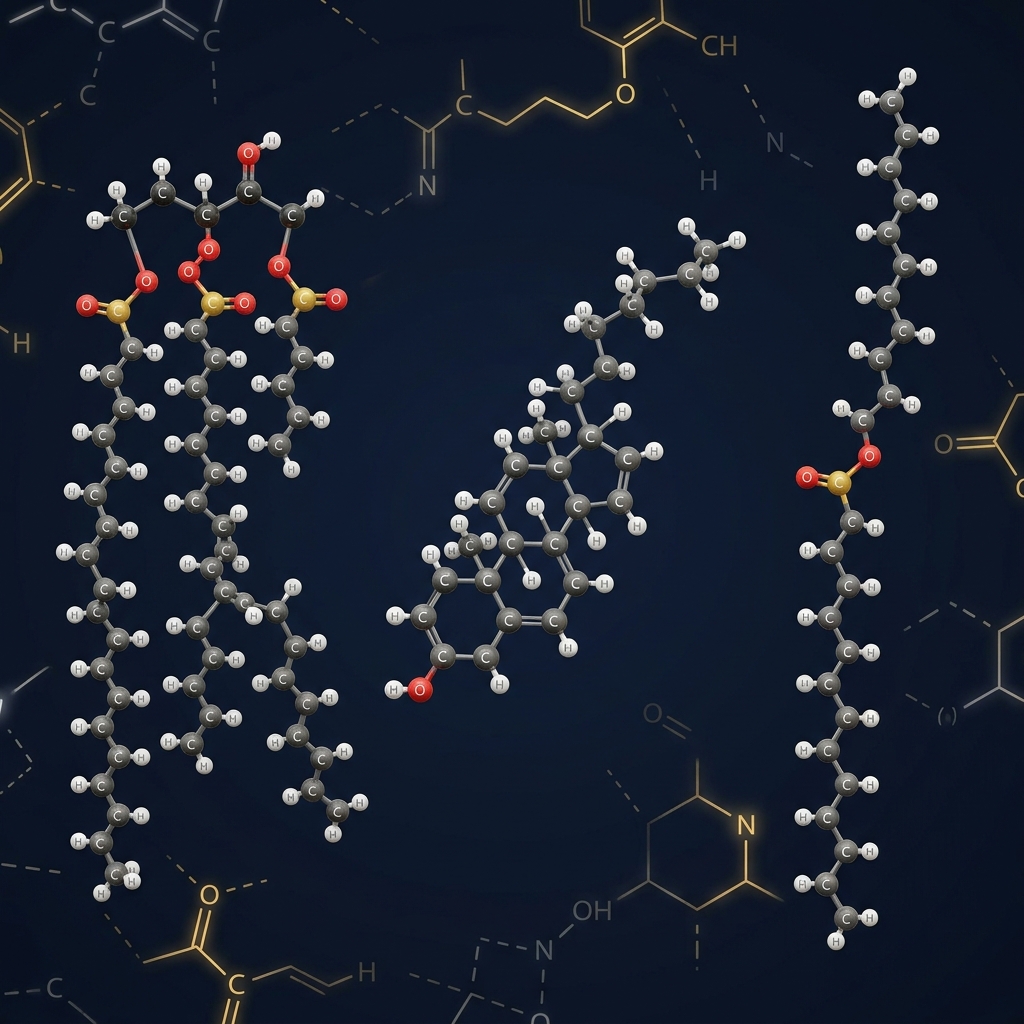
Fats, chemically known as triglycerides, consist of two primary components: a three-carbon polyol backbone called glycerol, and three long hydrocarbon chains known as fatty acids. These components are joined together through ester bonds during a dehydration synthesis (condensation) reaction, which releases three water molecules. The resulting triglyceride molecule is overwhelmingly nonpolar due to the extensive length of the fatty acid tails, making it highly hydrophobic.
Saturated vs. Unsaturated Fatty Acids
The chemical nature of the fatty acid tails determines the physical state of the fat. Saturated fats contain no carbon-to-carbon double bonds; their straight chains pack tightly, rendering them solid at room temperature (typical of animal fats). In contrast, unsaturated fats contain one or more double bonds (C=C), which introduce structural kinks that prevent tight packing, keeping them liquid at room temperature (typical of plant oils). Regardless of their saturation, triglycerides serve as the body’s primary long-term energy storage, providing 9 kcal/g of energy, and offer critical thermal insulation and organ cushioning.
Steroids: The Four-Ring Lipid
The Tetracyclic Carbon Skeleton (Rings A, B, C, D)
At first glance, steroids do not visually resemble fats, but they are firmly classified as lipids due to their profound hydrophobicity. Their core structure is universally defined by a tetracyclic carbon skeleton—three cyclohexane rings and one cyclopentane ring fused together, conventionally labeled A, B, C, and D. This rigid, nonpolar hydrocarbon structure repels water just as effectively as the long tails of a triglyceride. Distinct steroids are created by attaching different functional groups to this core framework.
Cholesterol as the Master Steroid Precursor
Cholesterol is the prototypical steroid molecule. It is an integral component of animal cell membranes, regulating fluidity and structural integrity. Furthermore, cholesterol serves as the biological precursor for all steroid hormones, including testosterone, estrogen, cortisol, and aldosterone. Because they are lipophilic, steroid hormones can effortlessly cross lipid bilayer cell membranes to reach intracellular receptors, allowing them to enact direct gene-level regulation. (It is worth noting that synthetic anabolic steroids are molecular derivatives of testosterone, specifically engineered while retaining this functional four-ring skeleton.)
Waxes: Nature’s Waterproof Coating
Long-Chain Fatty Acid + Long-Chain Alcohol = Wax Ester
Waxes are the most hydrophobic of all simple lipids. Chemically, a wax is formed by an ester bond connecting a very long-chain fatty acid (typically 16 to 36 carbons) to a very long-chain fatty alcohol (12 to 36 carbons). Unlike fats, waxes entirely lack a glycerol backbone. The sheer length of these two linear hydrocarbon chains maximizes their nonpolarity and creates extreme water repellency. Due to this high molecular weight, waxes are solid at biological and ambient temperatures.
Biological Roles: Cuticles, Earwax, and Feathers
Evolution has harnessed waxes strictly for their waterproofing capabilities. In plants, the waxy cuticle layer on leaves prevents fatal water loss (transpiration) and blocks pathogen entry. In the animal kingdom, waxes are equally critical: cerumen (earwax) protects the auditory canal, beeswax provides structural integrity to honeycombs, and the uropygial gland in aquatic birds secretes wax to waterproof their feathers, preventing them from becoming waterlogged.
What Fats, Steroids, and Waxes Share: The 4 Core Commonalities
Hydrophobicity and Water Insolubility
The primary commonality linking these three disparate structures is their shared chemical aversion to water. As outlined by resources like Khan Academy, whether it is the long tails of a fat, the four fused rings of a steroid, or the vast chains of a wax, all three molecules are predominantly built from nonpolar carbon-hydrogen bonds. This results in water insolubility and high solubility in organic solvents.
Carbon-Rich, High-Energy Molecular Structure
Because they are rich in reduced carbon bonds (C–C and C–H), lipids inherently store a massive amount of potential chemical energy. This dense energy profile explains why animals rely on fats for long-term fuel storage rather than bulky carbohydrates.
| Lipid Type | Core Structural Feature | Key Biological Function |
|---|---|---|
| Fats (Triglycerides) | Glycerol backbone + 3 fatty acid tails | Long-term energy storage, insulation |
| Steroids | 4 fused hydrocarbon rings | Hormonal signaling, membrane fluidity |
| Waxes | Long-chain alcohol + long-chain fatty acid | Waterproofing, environmental protection |
Lipid Classification in Biochemistry: Simple, Compound, and Derived
Simple Lipids: Fats and Waxes
In standard biochemistry, fats and waxes are classified as “simple lipids.” This category includes straightforward esters formed by fatty acids reacting with various alcohols. If the alcohol is glycerol, the result is a fat; if the alcohol is a long-chain monohydric molecule, the result is a wax.
Derived Lipids: Steroids and Their Significance
Steroids, along with fat-soluble vitamins (A, D, E, K), fall into the category of “derived lipids.” These molecules do not contain fatty acid chains or ester bonds in their core structure but are derived from simple or compound lipid hydrolysis and retain all essential lipid characteristics. This classification framework, commonly utilized in introductory microbiology and biochemistry, clarifies why structurally divergent molecules remain grouped together.
Biological Roles and Evolutionary Importance of Lipids
Energy Storage and Metabolic Efficiency
Evolution favored triglycerides for energy storage because they yield more than twice the metabolic energy per gram compared to carbohydrates or proteins. Furthermore, dietary fats are stored in an anhydrous state (without accompanying water weight), maximizing storage efficiency in adipocytes (fat cells).
Structural and Signaling Functions Across Life
Beyond energy, lipids act as the architectural foundation of life. Phospholipids and cholesterol create the fluid-mosaic cell membrane critical for all living cells. Steroids function as precision signaling molecules that modulate everything from systemic inflammation to reproductive cycles, while waxes provide the ultimate defensive barrier against environmental dehydration and pathogens.
Key Chemistry Concepts: Ester Bonds, Condensation, and Hydrolysis
How Ester Bonds Form and Break
The ester bond is central to the chemistry of both fats and waxes. It forms via a condensation reaction when the hydroxyl group (–OH) of an alcohol reacts with the carboxyl group (–COOH) of a fatty acid, expelling a molecule of water. In biological systems, specific enzymes called lipases can reverse this process through hydrolysis, breaking the ester bond by reintroducing water to release fatty acids for metabolic energy.
Saponification: The Chemistry Behind Soap
A prominent application of lipid chemistry is saponification. When fats are subjected to base-catalyzed hydrolysis (using a strong alkali like lye), the ester bonds break down, yielding glycerol and the fatty acid salts known chemically as soap. While steroids do not undergo saponification due to their lack of ester bonds, this fundamental chemical reaction underscores the unique properties of simple lipids.
Get our latest guides, news, and insights highlighted in your Google Search & AI Overviews.