Executive Summary: The short answer to “does the Army test for steroids” is yes, but typically not through standard random urinalysis. Routine military drug tests screen for recreational drugs (like THC, cocaine, and amphetamines). Anabolic steroid testing is highly specialized, expensive, and generally requires “probable cause” or command direction. However, the military maintains a strict zero-tolerance policy under UCMJ Article 112a, meaning any unauthorized use, possession, or distribution of performance-enhancing drugs (PEDs) can result in a court-martial and dishonorable discharge. Recent shifts in Special Operations policies indicate that random testing for PEDs may become more common in the future.
One of the most common questions asked by new recruits and active-duty service members alike is: does the Army test for steroids? While the military’s standard urinalysis is highly effective at catching illicit recreational drugs, performance-enhancing drugs (PEDs) fall into a different category. With strict regulations under the Uniform Code of Military Justice (UCMJ) and recent policy shifts among Special Operations Forces, understanding the military’s stance on anabolic steroids, SARMs, and supplements is crucial for anyone in uniform.
The Military Policy on Steroids and PEDs
UCMJ Article 112a Explained
The foundation of the military’s drug policy is Article 112a of the UCMJ. This article explicitly prohibits the wrongful use, possession, manufacture, or distribution of controlled substances, which includes Schedule III drugs like anabolic steroids. If a soldier does not have a valid, military-approved medical prescription for testosterone or other steroids, possessing or using them is a direct violation of federal military law.
Why Steroids Are Treated Differently Than Illicit Drugs
Unlike cocaine or marijuana, steroids do not typically cause immediate acute intoxication that impairs duty performance in the short term. Instead, they are often used by service members misguidedly attempting to improve physical fitness scores or recover from injuries. Despite these intentions, the Department of Defense (DOD) treats PEDs as illicit substances because they pose significant long-term health risks associated with anabolic steroids, including cardiovascular damage, liver toxicity, and severe psychological effects (often termed “roid rage”), which compromise unit readiness and safety.
Does the Army Test for Steroids in Random Urinalysis?
The Standard Drug Testing Panel
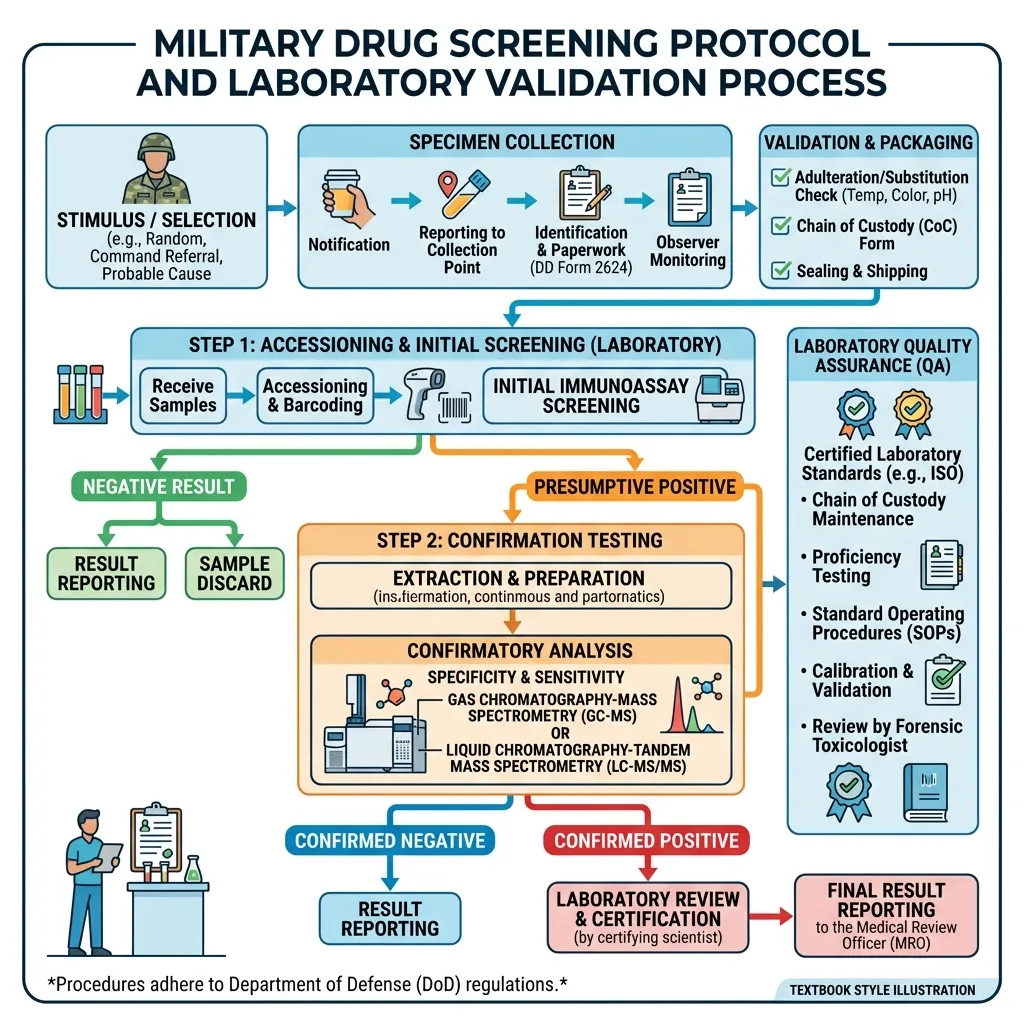
When an Army unit conducts a standard random urinalysis (the “meat gaze” testing that all soldiers undergo), the urine is typically sent to a DOD lab to be screened for a specific panel of drugs. This standard panel routinely checks for:
- Marijuana (THC)
- Cocaine
- Amphetamines/Methamphetamines
- MDMA (Ecstasy)
- Opiates and synthetic opioids (like fentanyl or oxycodone)
Why Routine Steroid Testing Is Uncommon
Standard random military drug tests do not routinely screen for anabolic steroids. The reason is primarily logistical and financial. Testing for PEDs requires a specialized process using gas chromatography/mass spectrometry (GC/MS) specifically calibrated for synthetic hormones. These tests are significantly more expensive than standard drug screens. Testing millions of service members for steroids randomly would drain the Army Substance Abuse Program (ASAP) budget. Therefore, the Army reserves steroid testing for specific scenarios.
When and How the Military Tests for Steroids
Probable Cause and Command-Directed Testing
If the Army does not test randomly for steroids, how do soldiers get caught? The answer is probable cause or command-directed testing. A commanding officer can request a specific steroid screening if they have reasonable suspicion that a soldier is using PEDs. Triggers for probable cause include:
- Rapid, unnatural gains in muscle mass and strength.
- Severe, uncharacteristic mood swings or aggressive behavior.
- Physical evidence, such as finding vials, syringes, or packaging in the barracks.
- Witness testimonies or tips from other service members.
The Specialized Lab Process (DOD-Certified Labs)
When a command-directed steroid test is ordered, the urine sample is flagged and sent to a specialized DOD-certified laboratory (such as the facility at Fort Meade). These labs possess the equipment necessary to detect synthetic testosterone, trenbolone, nandrolone, and other common anabolic compounds. If the test returns positive without a corresponding medical prescription in the soldier’s medical records, a criminal investigation is launched.
Reasons Soldiers Risk PED Use
- Pressure to pass rigorous physical fitness tests (ACFT).
- Desire for faster recovery from training injuries.
- A competitive culture prioritizing physical dominance.
- Misinformation regarding the safety of SARMs and prohormones.
Military Consequences of PED Use
- Immediate suspension of security clearances.
- Reduction in rank (busting down to E-1).
- Forfeiture of pay and allowances.
- Other-than-honorable or dishonorable discharge.
Are Special Operations Forces Tested Differently?
The 2023 Navy SEALs Policy Shift
While the conventional Army relies on probable cause, Special Operations Forces are currently undergoing a massive policy shift. In November 2023, the Naval Special Warfare (NSW) Command instituted force-wide, random urinalysis testing specifically for performance-enhancing drugs for Navy SEALs and Special Warfare Combatant-craft Crewmen (SWCC). This unprecedented move was triggered by the tragic death of a SEAL candidate during Hell Week, which brought the prevalence of PEDs in elite units to light.
Potential Future Changes for Army Special Operations (USASOC)
The Navy’s policy change has set a strong precedent. Army Special Operations Command (USASOC), which oversees Rangers, Green Berets, and Delta Force, is closely monitoring the NSW program. It is highly likely that random, force-wide steroid testing will eventually be implemented for Army Special Operations, and potentially trickle down to conventional infantry units as testing costs decrease over time.
The Consequences of a Positive Steroid Test
Disciplinary Actions and Court-Martial
A positive test for anabolic steroids is treated as a severe breach of discipline. The soldier will likely face non-judicial punishment (Article 15) or, more commonly for drug offenses, a court-martial. Penalties under a court-martial can include confinement in a military prison, total forfeiture of all pay, and a punitive discharge.
Administrative Separation and Career Loss
Even if a soldier avoids a court-martial, they will almost certainly face administrative separation (kicked out of the Army). A discharge related to drug abuse is typically categorized as Under Other Than Honorable Conditions (UOTHC). This strips the soldier of their GI Bill benefits, VA home loan eligibility, and can severely impact civilian employment prospects.
Warning on SARMs: Selective Androgen Receptor Modulators (SARMs) are NOT legal dietary supplements. The DOD strictly bans the use of SARMs (like Ostarine and RAD-140). A positive test for SARMs carries the exact same UCMJ penalties as a positive test for injectable anabolic steroids.
The Danger of Dietary Supplements and SARMs
Contaminated Over-the-Counter Products
Many soldiers inadvertently consume banned substances through poorly regulated pre-workouts or dietary supplements bought online or even at off-base nutrition stores. The FDA does not heavily regulate dietary supplements, and independent testing frequently finds products contaminated with unlisted synthetic androgens or stimulants.
Operation Supplement Safety (OPSS) Resources
To combat this, the Consortium for Health and Military Performance created Operation Supplement Safety (OPSS). Service members are highly encouraged to use the OPSS portal to check the DOD prohibited dietary supplement ingredients list before consuming any pre-workout, fat burner, or protein powder. Ignorance of a supplement’s ingredients is not a valid defense at a court-martial.
Get our latest guides, news, and insights highlighted in your Google Search & AI Overviews.