Eight consecutive Mr. Olympia titles. A competition weight approaching 300 lbs at 5’11”. Squats and deadlifts with 800+ lbs on the bar. Ronnie Coleman is, by nearly every measure, the greatest professional bodybuilder who ever lived — and for decades, one of the sport’s most hotly debated questions was whether his superhuman physique was built with pharmaceutical assistance. The answer, in Coleman’s own words on the Joe Rogan Experience and numerous other platforms, is yes. But the real story is far more nuanced than a simple yes or no: when did he start, what did he actually take, how did he navigate the law, and what is the devastating physical price he is still paying today?
Ronnie Coleman’s Career at a Glance: From Police Officer to ‘The King’
Early Life, Grambling State Football, and the Accidental Bodybuilder
Born in 1964 in Monroe, Louisiana, Ronnie Coleman earned an accounting degree from Grambling State University, where he also played middle linebacker. Struggling to find work in his field, he joined the Arlington Police Department in Texas in 1989. He served as a full-time officer until 2000 (and a reserve officer until 2003). His entry into bodybuilding was accidental: Brian Dobson, owner of the legendary Metroflex Gym, offered him a free membership if he agreed to compete in an upcoming show. This set the stage for a career that would change the sport forever.
Eight Consecutive Mr. Olympia Titles (1998–2005)
Coleman tied Lee Haney’s seemingly unbreakable record of eight consecutive Mr. Olympia wins. During his peak, his competition weight sat between 287 and 300 lbs—even pushing past 300 lbs at the 2004 Grand Prix—while his off-season weight routinely hit 315 to 330 lbs. The fact that he achieved these unprecedented proportions while actively serving as a police officer added a layer of profound authenticity and mystique to his legacy.
The Natural Phase: Did Ronnie Coleman Ever Compete Clean?
Six Years of Drug-Free Training (1991–1996)
A common misconception is that Coleman relied on PEDs from day one. In reality, Coleman has stated that he trained and competed naturally for the first six years of his bodybuilding career. He competed in drug-tested shows in the early 1990s and was already known for his freakish, “supernatural” strength. Even before utilizing steroids, his elite genetics allowed him to build a world-class physique with 24-inch arms.
The Turning Point: Frustration, Genetics, and a Third-Place Ceiling
The turning point arrived when Coleman hit age 30. Despite his incredible natural foundation, he found himself consistently placing third behind competitors he knew were using performance-enhancing drugs. Frustrated by this artificial ceiling, he made the calculated decision to level the playing field. He credits fellow competitor Flex Wheeler with introducing him to his first supply of steroids and connecting him with legendary bodybuilding coach Chad Nicholls.
Did Ronnie Coleman Admit to Using Steroids? His Own Words
The Joe Rogan Experience #1489 (2020): The Most Candid Confession
For years, IFBB professionals strictly adhered to an unwritten code of silence regarding drug use. However, during his highly publicized appearance on The Joe Rogan Experience (#1489) in 2020, Coleman explicitly confessed. He confirmed his use of testosterone and Dianabol, casually referring to them as “just basic stuff.” He rationalized his usage by comparing the bodybuilding landscape to the steroid era of professional baseball, noting, “People aren’t stupid”—everyone at the elite level understood what was required to compete.
Why He Was More Open Post-Retirement
Post-retirement, Coleman no longer had lucrative sponsor contracts or competitive standings to protect, allowing him to speak with unprecedented transparency on various podcasts. Interestingly, the 2018 Netflix documentary Ronnie Coleman: The King notably omits any direct discussion of steroids, focusing instead on his legendary work ethic and his subsequent spinal surgeries.
What Steroids Did Ronnie Coleman Actually Use?
Confirmed Compounds: Testosterone and Dianabol
While internet forums wildly speculate about complex pharmaceutical cocktails, Coleman himself has only explicitly confirmed the use of basic testosterone (likely various esters) and the oral steroid Dianabol. He utilized these compounds to push past his natural limits, recover from grueling twice-daily workouts at Metroflex, and retain lean tissue while dieting down for shows.
The ‘Mass Monster’ Era Stack: What IFBB Pros of the 1990s–2000s Used
To contextualize his regimen, one must look at the era. In the late 1990s and early 2000s, IFBB professionals commonly stacked nandrolone (Deca-Durabolin) for joint lubrication, trenbolone for dense lean mass, and Winstrol for pre-contest drying. Furthermore, this era saw the widespread integration of Human Growth Hormone (HGH) and insulin for extreme nutrient partitioning. While Coleman has not detailed his exact dosages of these ancillary drugs, they were standard protocol for the elite competitors he routinely defeated.
The DEA, Prescriptions, and the Legal Gray Zone
Obtaining Steroids Through HRT Clinics
As his career progressed and his profile expanded, Coleman shifted his approach to obtaining PEDs. For the final five to six years of his competitive career, he stopped buying underground gear and began acquiring testosterone and growth hormone legally through legitimate Hormone Replacement Therapy (HRT) clinics, complete with valid prescriptions and regular blood monitoring.
The 2002 DEA Investigation and Grand Jury Testimony
This legal foresight proved invaluable. Around 2002, the DEA launched a major investigation into the professional bodybuilding world. Coleman, like many other athletes, was called to testify before a grand jury. Because he possessed legitimate, written prescriptions from licensed physicians, he avoided the devastating legal consequences that ruined the careers of several underground athletes and distributors during that sting.
The Physical Toll: Ronnie Coleman’s Health After Steroids and Extreme Training
More Than a Dozen Surgeries: A Timeline of Spinal Damage
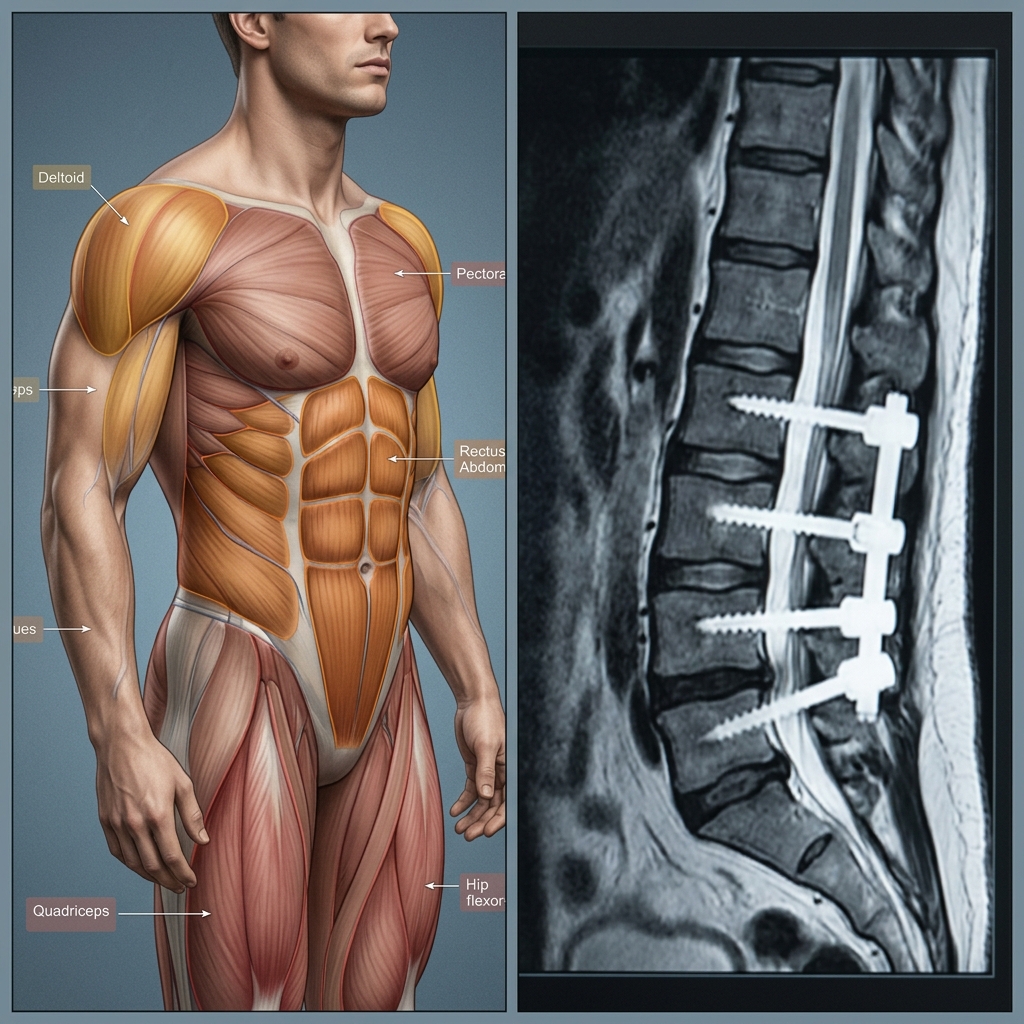
Today, Ronnie Coleman pays a severe physical price for his legacy. He has endured more than a dozen major surgeries, including multiple spinal fusions, severe decompressions, neck surgeries, and double hip replacements. He suffered his first herniated disc in 1996 but continued to lift and compete through excruciating pain for another decade.
Crutches, Wheelchairs, and Sepsis: Life After the Olympia Stage
Post-retirement, surgical complications have frequently left him reliant on crutches or a wheelchair. He even spent time in the ICU battling sepsis. The medical consensus is that his physical breakdown is the cumulative result of a perfect storm: extreme heavy lifting (squatting 800 lbs), genetic predispositions, and the long-term effects of AAS, which clinical literature shows can degrade connective tissue integrity as muscle growth outpaces tendon strength. Yet, when asked, Coleman insists he has absolutely no regrets.
Science Behind the Physique: What Steroids Actually Did for Coleman
Muscle Hypertrophy, Recovery, and Body Composition
Steroids did not build Ronnie Coleman; his work ethic did. What the drugs provided was an extreme enhancement in recovery. By heavily activating androgen receptors, steroids exponentially increased his protein synthesis and myonuclei density. Coleman himself noted that steroids primarily changed his conditioning and fullness, not his raw strength—he was already squatting enormous weights naturally.
Long-Term Health Risks of Anabolic Steroid Use: What Research Shows
According to the National Institute on Drug Abuse, chronic supraphysiologic steroid use carries profound health risks. Cardiovascular studies link long-term AAS use to left ventricular hypertrophy, cardiomyopathy (with up to a 9x higher risk of heart failure), adverse lipid profiles, and permanent endocrine suppression. Coleman’s survival and ongoing training, despite these risks, speaks to his unique physiological resilience.
Legacy and Lessons: What Ronnie Coleman’s Story Means for the Sport
The ‘Mass Monster’ Era and Its Lasting Influence
Ronnie Coleman, alongside Dorian Yates, defined the “mass monster” era—a period where sheer size pushed the boundaries of human biology. While modern bodybuilding has attempted to balance size with aesthetics (via the Classic Physique division), the Open division still chases the standard Coleman set. The IFBB Pro League remains an untested organization, operating in a unique space where PED use is acknowledged but rarely penalized.
Steroids, Transparency, and the Modern Conversation
Coleman’s post-retirement transparency has forced a necessary conversation about the realities of elite bodybuilding. He vehemently maintains that drugs were only a fraction of the equation; genetics and an inhuman tolerance for pain were the true differentiators. His story stands as both the ultimate testament to human physical potential and a stark, sobering cautionary tale regarding the long-term price of greatness.
Get our latest guides, news, and insights highlighted in your Google Search & AI Overviews.